
Detailed Guide to Glass Tube Bending Processes

Glass tube bending is an important processing technique used to manufacture customized glass components for laboratory equipment, industrial systems, and scientific instruments. By heating and shaping glass tubes under controlled conditions, manufacturers can create different angles, curves, and complex structures while maintaining the required dimensions.
1. Glass Tube Material Selection
Different glass materials require different bending temperatures and processing methods.
-
Borosilicate glass: Offers good thermal shock resistance and chemical stability, making it suitable for laboratory and industrial applications.
-
Quartz glass: Suitable for high-temperature applications and specialized industrial equipment.
-
Other specialty glass: Selected according to specific optical, thermal, or chemical requirements.
2. Heating and Softening
The bending area is heated using suitable equipment, such as a glassworking burner or specialized heating system.
The temperature must be carefully controlled to soften the glass evenly. Insufficient heating may cause cracking, while excessive heating can lead to deformation or uneven wall thickness.
3. Bending and Shape Forming
Once the glass reaches the appropriate working condition, it is gradually bent into the required shape.
Common bending designs include:
-
90-degree glass tube bends
-
U-shaped glass tubes
-
S-shaped glass tubes
-
Custom curved glass tubes
-
Multi-angle glass tube structures
During forming, manufacturers must control the bending radius, angle, alignment, and cross-sectional shape.
4. Annealing and Stress Relief
After bending, residual stress may remain inside the glass. Controlled annealing allows the material to cool gradually, reducing internal stress and lowering the risk of cracking during later use.
Different glass materials require different annealing temperatures and cooling schedules.
5. Inspection and Quality Control
Finished glass tubes should be inspected for dimensional accuracy, surface defects, cracks, deformation, and wall thickness consistency.
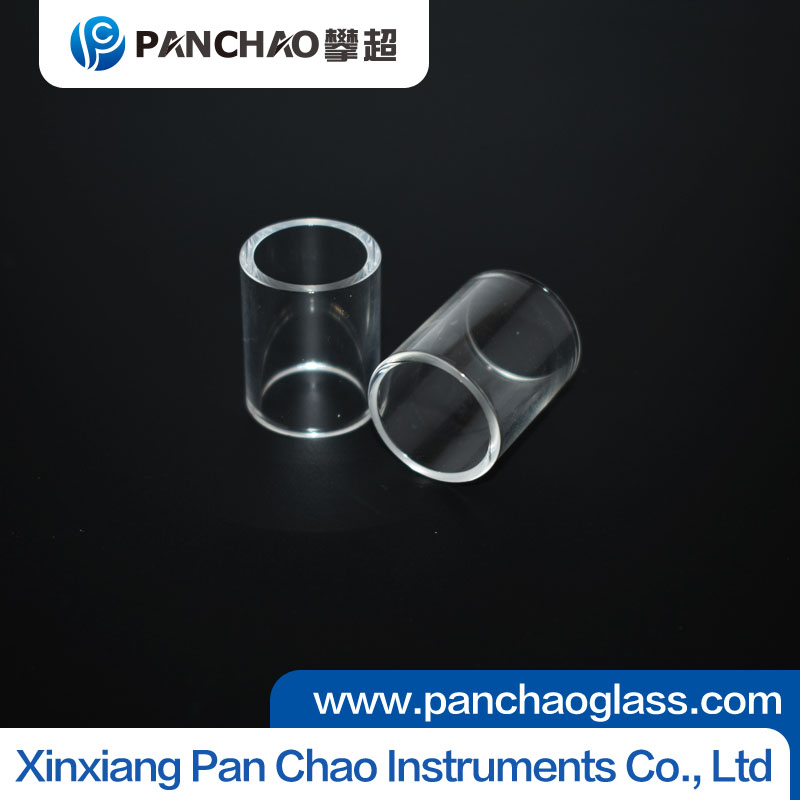
At Pan Chao, we provide customized borosilicate and quartz glass tube processing, including bending, cutting, polishing, and dimensional customization. Through controlled processing and careful inspection, we help customers obtain glass tube components that meet their specific application requirements.

Related articles
- Thermal Expansion Coefficients of Different Glass Materials
- Optical Transmission Advantages of Quartz Sight Glass
- Comparison of Three Major Glass Materials: Borosilicate, Quar
- High Temperature Borosilicate Glass with Stable Chemical Perf
- Borosilicate Glass vs Tempered Glass: Thermal Resistance &
- Durable Borosilicate and Quartz Sight Glass for Process Monit
- Tempered Sight Glass with High Mechanical Strength and Safety
- Borosilicate Sight Glass for Pipeline, Tank and Reactor Monit
- Heat-Resistant Borosilicate Glass Plate for Laboratory and In
- Fused Silica Quartz Sight Glass with High UV and IR Transmiss

Xinxiang Pan Chao Instruments Co., Ltd.
Tel: +86 13343800331
Contact person:Carrie Niu
Fax: 0373 303 0331
Email:sales@panchaoglass.com
