
Glass Thickness, Diameter, and Flatness: How Specifications Affect Performance
PCHAO brand industrial sight glass give you professional custom!
Website:www.panchaoglass.com
Address:Room 1624, Jing Ye Gong Yuan Guo Ji, Jin Sui road and New Second Street intersection, Xin Xiang city, Henan Province, China
Phone: +8613569413718

When ordering glass components, thickness, diameter, and flatness are three specifications that directly influence fit, strength, optical behavior, and long-term reliability. Many buyers focus only on material type, but even high-quality glass can underperform if these dimensional parameters are not properly defined. Understanding their impact helps avoid assembly issues, breakage, and unnecessary rework.
Thickness: Strength, Thermal Response, and Optical Behavior
Glass thickness affects mechanical strength, pressure resistance, and thermal performance. Thicker glass generally provides better load-bearing capacity and impact resistance, which is important for sight glasses, protective windows, and structural components. However, increased thickness also means slower heat transfer and higher susceptibility to internal stress if cooling is not uniform. In optical applications, thickness variation can cause light path deviation, distortion, or measurement errors. Therefore, thickness should be selected based on mechanical load, temperature change, sealing requirements, and optical precision, not simply chosen as “thicker is safer.”
Diameter and Dimensional Tolerance
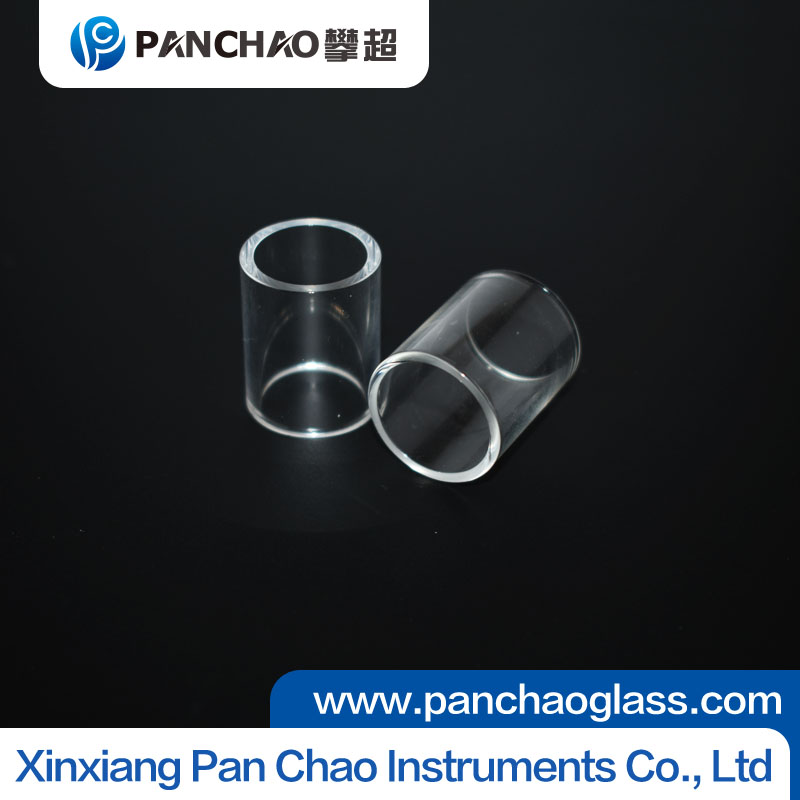
Diameter and other linear dimensions determine whether a glass component fits correctly into a housing, flange, instrument, or assembly. For tubes, rods, discs, and custom-cut parts, even small deviations can cause loose fits, sealing failures, or installation difficulties. Tight tolerances are especially important when glass must mate with metal, ceramic, or polymer parts. If a component will be drilled, chamfered, or edge-ground, the final diameter should be confirmed after processing, because machining can change the original size. Clear dimensional drawings and tolerance ranges help suppliers produce parts that meet actual assembly needs.
Flatness: Contact, Sealing, and Optical Accuracy
Flatness refers to how evenly a glass surface lies across its area. Poor flatness can create gaps during assembly, reduce sealing performance, and cause uneven stress when the glass is clamped. In optical and inspection applications, flatness affects image quality, laser beam transmission, sensor accuracy, and surface contact. For precision windows, base plates, and optical substrates, flatness requirements are usually stricter than for general-purpose glass. If the glass will be bonded, polished, or used as a reference surface, flatness should be specified together with surface quality and edge treatment.
Why Specifications Should Be Defined Early
Thickness, diameter, and flatness do not work independently. A change in one parameter may affect the others during cutting, grinding, annealing, or inspection. Buyers should provide complete specifications before production, including material type, size, tolerance, edge finish, surface quality, and intended operating environment. Early communication with the supplier ensures that processing methods, inspection standards, and packaging requirements are aligned with the final application.
Clear specifications are the foundation of reliable glass components. By defining thickness, diameter, and flatness accurately, buyers can improve assembly efficiency, reduce defects, and ensure stable performance across industrial, laboratory, optical, and instrumentation applications.

Related articles
- How to Select Glass for High-Temperature, Chemical, and Optic
- Why Can't Tempered Glass Tubes Be Processed Again? — Decodi
- The Bending Process for Shaped Glass Tubes: Differences Betwe
- Why Are "Straightness" and "Roundness" So Important f
- Precise Calculation of Glass Tube Wall Thickness and Pressure
- How Are "Striae" and "Bubble" Defects Controlled in O
- Why Do Glass Tubes Need "Flame Polishing" After Cutting?
- From Sand to Tube: The Raw Materials and Melting Process of B
- What Wall Thickness Tolerances Can Be Achieved for Custom Gla
- How Is "Internal Stress" in Glass Tubing Created? — A C
Products
acrylic display center

Contact Us

Xinxiang Pan Chao Instruments Co., Ltd.
Tel: +86 13343800331
Contact person:Carrie Niu
Fax: 0373 303 0331
Email:sales@panchaoglass.com
